A front loader asks for a premium up front, and the five-star sticker will not tell you what it buys. The label rates energy only, never water. It also scores the two machine types on different wash cycles. So in the front load vs top load argument, the stars settle nothing. I would buy the top loader, unless water is the expensive part of your household bill.
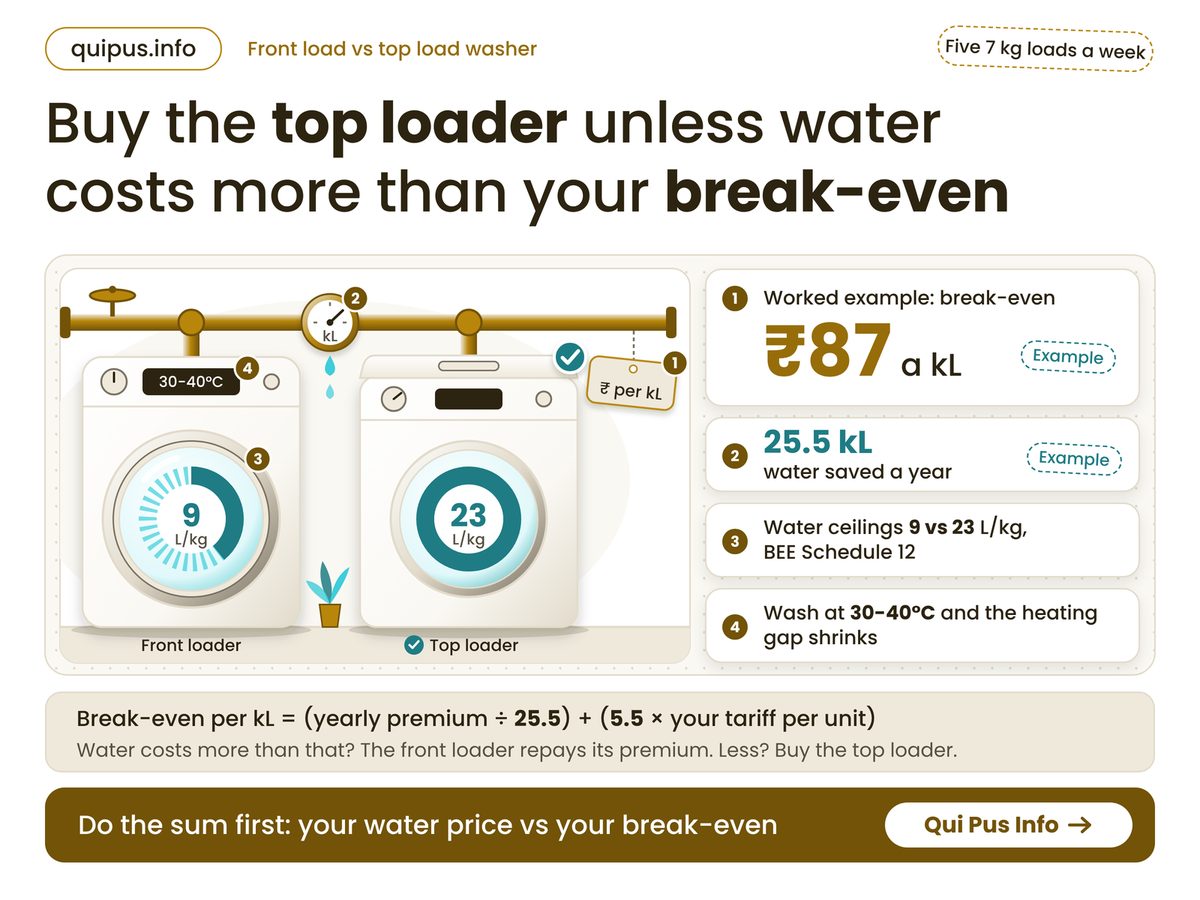
Buy the top loader unless your water price beats a threshold you can work out in a minute.
- BEE sets water only as a pre-qualification ceiling, never as a star band, so the label cannot answer the water question.
- Five stars on each type come from 60°C and 30°C test cycles, so the stars do not compare.
- Threshold, at five 7 kg loads a week: yearly premium ÷ 25.5, plus 5.5 × your tariff per unit, in rupees per kilolitre. Water dearer than that favours the front loader.
Front load vs top load: does the star label settle it?
No: BEE's Schedule 12 scores front loaders on a 60°C cotton cycle and top loaders on a 30°C one, and it grades energy only, so five stars on each cannot be compared. The schedule's own words, section 1.2: the "star rating shall be based on per-cycle energy consumption per kg". Stars measure power, not water. The tables are headed "Valid from 8th March 2019 to 31st December 2020", and BEE's appliance page, read on 19 November 2026, still lists washing machines as voluntary.
A five-star front loader may use up to 0.09 kWh a kilogram on its 60°C cycle; a five-star top loader, 0.0132 on a 30°C one. That looks like a gulf. Mostly it is a different test. So I disagree with the advice to "pick the higher star" across the two types.
Water is where the label goes silent. Section 7.3 sets pre-qualification ceilings, not ratings: 9 L/kg a cycle for front loaders, 23 L/kg for top loaders. On a 7 kg load that is at most 63 L against 161 L. A ceiling is a limit, not what a machine drinks, so read the gap as the front loader's best case. Heating its water costs too, as our gas versus electric geyser cost per bath note shows. And a dearer machine only wins when it saves more a year than its price spread over its life, the test in our BLDC fan payback sum.
Four derived numbers show how far the label can be trusted.
Water Gap Per 7 kg Wash
98 L
Ceiling gap, not measured use
Heating Gap Per 7 kg Wash
0.54 kWh
Front loader's rated cycle, derived
Front-To-Top Energy Band
6.8x
Different cycles, not different machines
Age Of The Printed Tables
5.9 years
Past their stated validity
The heating gap is the quiet counterweight to the water saving. A front loader's rated cycle heats what it uses, and with a geyser or immersion rod that cost lands on your electricity bill.
The label counts energy and ignores water. The saving a front loader promises is only as real as the water you actually pay for.
How long does a front loader take to repay its premium?
On the Schedule 12 ceilings, a front loader repays a ₹10,000 premium in about 7.6 years if your water costs ₹90 a kilolitre, and never if it costs ₹20 or ₹40. That is our arithmetic, not a BEE figure, and every rupee here is an input you replace: I have not sourced a retailer price. Your last bill or tanker receipt gives your water rate.
Worked example: assume a 7 kg load, five loads a week (260 a year), electricity at ₹7 a unit, a ₹10,000 premium spread over 8 years, and both machines at their five-star energy ceilings. Water saved: 14 L per kg × 7 kg × 260 loads = 25.5 kL a year. Extra heating: (0.09 − 0.0132) × 7 × 260 = 140 kWh, or ₹978. Yearly premium: ₹10,000 ÷ 8 = ₹1,250. Break-even water price: (₹1,250 + ₹978) ÷ 25.5 = ₹87 a kL. With no premium at all, heating alone breaks even at ₹38.
Find your water price down the side, then read across at the quoted premium. Each cell is the years the front loader takes to repay it.
| Water price | ₹6,000 | ₹10,000 | ₹20,000 |
|---|---|---|---|
| ₹20 a kL | Never | Never | Never |
| ₹40 a kL | 20+ yrs | 20+ yrs | 20+ yrs |
| ₹90 a kL | 4.6 yrs | 7.6 yrs | 15.2 yrs |
| ₹150 a kL | 2.1 yrs | 3.5 yrs | 7.0 yrs |
| ₹250 a kL | 1.1 yrs | 1.9 yrs | 3.7 yrs |
Our arithmetic: the bold cell is the worked example, 7.6 years, just inside an 8-year life. One row down it falls to 3.5 years. At ₹40 the premium never comes back. Find your own row; that is the decision.
Decision: how much water can a front loader possibly save? At most about 61 per cent of the top loader's allowance, so the premium must be repaid from that slice. Our arithmetic: (23 − 9) ÷ 23 from Schedule 12 section 7.3, ceilings as limits.
Where does the front loader's saving fall apart?
The saving shrinks when your water is cheap or real use sits below the ceilings, and a repair bill can eat the premium: the ceilings are limits, not measured use. Washing at 30°C to 40°C erases most of the heating gap, and that is the best case for a front loader.
Repairs are the unpriced part. Owners split. Or rather, two owners did, and two is not a sample. In an undated thread on the Techenclave buying forum, one owner wrote that a Whirlpool front loader needed only a new bearing and seal after about nine years. Another said a previous top loader was opened several times for repairs. Neither gave a rupee figure, and I found no verified front load washing machine repair cost.
- Price the premium on a real shop page: it is the biggest number in the sum, and our price-history low versus list-price discount note shows the check.
- Read the model's own manual for litres per wash; the ceiling is only a limit.
- Count your real loads: three a week cut the saving to 60 per cent of the example, seven lift it to 140.
- Tanker or RO water already carries a rupee price; see our RO purifier maintenance cost over five years note.
Check these before you pay the premium
- Your last water bill or tanker receipt shows a rate above your break-even.
- You wash mostly at 60°C, the cycle a front-loader label is rated on.
- The model's manual prints a litres-per-wash figure.
- The front loader's price is on a retailer page, not only a flyer.
Do one sum this week. Divide the front loader's extra price by 8, divide that by 25.5, then add 5.5 times your electricity rate in rupees a unit. That is your break-even water price per kilolitre. If your bill is above it, buy the front loader; if not, buy the top loader. The call is wrong if you wash cold all year or your loads differ much from five a week, so rerun the calculator and check the live tables on BEE's labelling page. Next read: what a 5-star AC will have to meet from 2028.
How we checked this
We read BEE Schedule 12 for washing machines (section 7.3, tables 3 and 4) and BEE's Standards and Labelling page, both on 19 November 2026. The worked example is our arithmetic on 7 kg, 260 loads, ₹7 a unit and a ₹10,000 premium over 8 years. No product was tested hands-on for this article.
Last verified: 19 November 2026
Edited by Ansari, reviewed after publication. Spotted something out of date? Tell us and we will correct it.
No comments:
Post a Comment
Note: Only a member of this blog may post a comment.