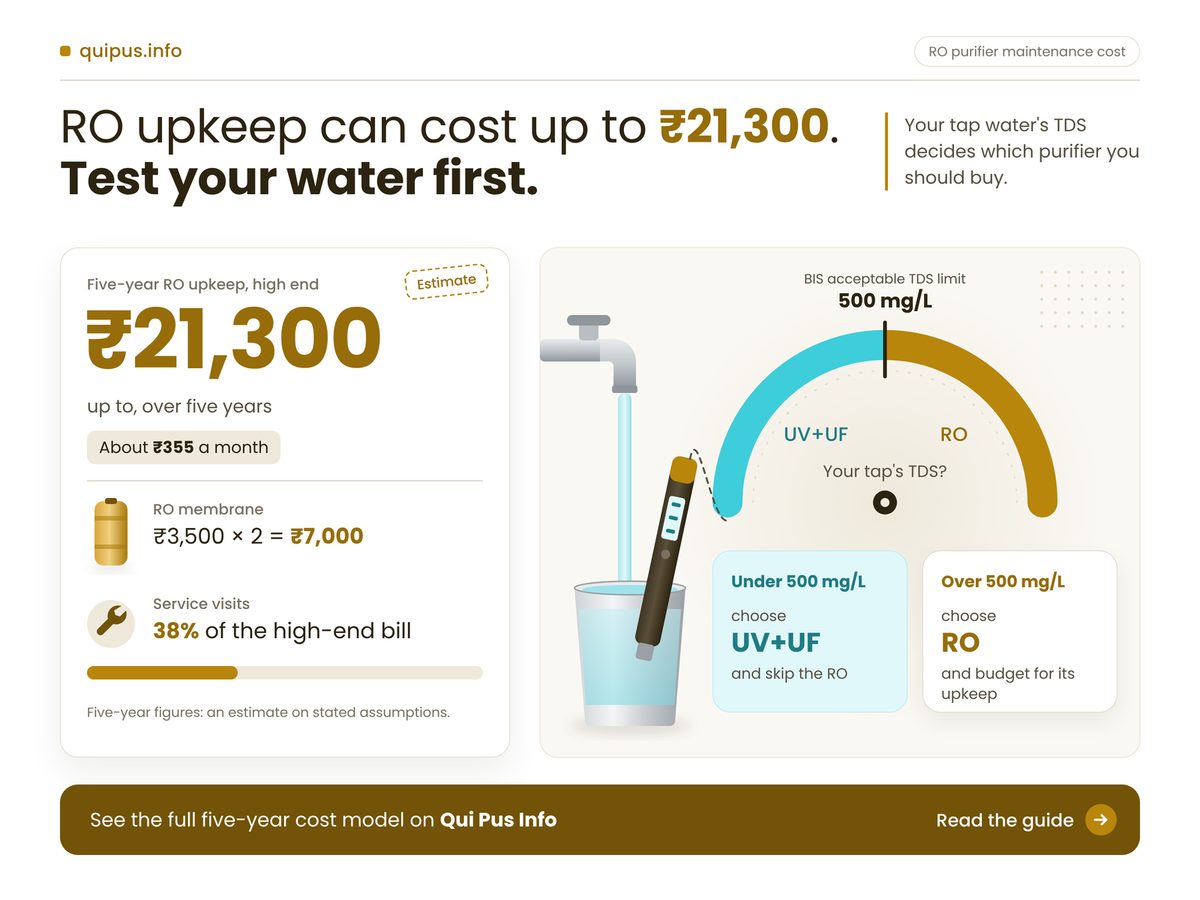
Up to ₹21,300 over five years. That is where RO purifier maintenance cost lands on this site's model, with top-of-market parts and a technician twice a year, all spent after the box is paid for. The cheaper buy, if your tap water tests below 500 mg/L of dissolved solids, is a UV+UF purifier, which has no membrane to replace.
Key Takeaways
Test your tap water's TDS before you buy: under 500 mg/L, choose UV+UF; over it, choose RO and budget for its upkeep.
- Five years of RO+UV upkeep: ₹8,950 to ₹21,300 on June 2026 part prices.
- Service visits, not the membrane, are the largest share of that bill.
- UV+UF drops the membrane line, worth ₹2,400 to ₹7,000 over five years.
- An RO with four years of parts and service included absorbs most of the bill, if the warranty card agrees.
What makes up RO purifier maintenance cost?
Four lines make up the bill: filters, the membrane, the UV lamp and the service visits, and on a five-year model built from June 2026 Indian part prices, the visits outweigh any single part.
Most advice fixes on the membrane, the dearest part. Wrong fear, in our view: on our assumptions it is changed twice in five years, while the doorbell rings ten times. The prices below are reported ranges from RO Care India's 4 June 2026 Kolkata price guide; it is a service network, not a brand.
Worked example: an RO+UV purifier on hard city water, top-of-range parts, a service visit every six months. Our assumptions, not the guide's: filters yearly, the membrane twice in five years, the UV lamp once.
- Sediment filter (₹150-400) plus carbon filter (₹200-500), one set a year: ₹900 x 5 = ₹4,500.
- RO membrane (₹1,200-3,500), twice: ₹3,500 x 2 = ₹7,000.
- UV lamp (₹800-1,800 with installation), once: ₹1,800.
- General service visit (₹400-800), twice a year: ₹800 x 10 = ₹8,000.
That totals ₹21,300, about ₹355 a month. At the bottom of every range it falls to ₹8,950, and since the guide ties membrane prices to quality and brand compatibility, much of that gap is the part you accept. Your own version takes under a minute: last service bill times ten, plus five years of filter sets at your technician's price. That is your floor before any membrane.
It is the same ownership sum as the payback for 3-star and 5-star refrigerators, and it belongs before the festive sale, when a list price dressed up as a discount flatters the box.
Four more numbers decide whether your bill stays near that floor. Two come from the same guide, the others from BIS's IS 10500:2012 standard and the National Green Tribunal's May 2019 order, which the environment ministry reported to the Lok Sabha on 13 March 2020.
Service interval
3-6 months
Two to four visits a year
Full overhaul
₹3,500-7,000
Where skipped visits end up
Highest TDS allowed
2,000 mg/L
Past it, water fails BIS outright
Water an RO should keep
Over 60%
The rest drains as reject water
The overhaul is the figure to plan around. Skip visits to save money and the saving can return as that one bill, bigger at either end of the price range than a year of routine upkeep.
The membrane gets the blame. The doorbell, ringing every few months for five years, is what an RO really costs you.
RO or UV: which costs less to keep?
UV+UF costs less to keep because it has no RO membrane to replace, though the saving only counts if your tap water already sits under 500 mg/L of dissolved solids, BIS's acceptable limit.
Find your row, then read across at your technician's price. The UV+UF row drops the membrane but omits the UF cartridge, which the guide does not price, so read it as a floor. The last row is an RO with four years of parts and service included, leaving only year five to pay.
| Purifier | Low end | Midpoint | High end |
|---|---|---|---|
| RO + UV | ₹8,950 | ₹15,125 | ₹21,300 |
| UV + UF | ₹6,550 | ₹10,425 | ₹14,300 |
| RO, 4-yr cover | ₹1,150 | ₹1,825 | ₹2,500 |
The tinted cell is the worked example. Midpoint prices take ₹6,175 off it; UV+UF at the same prices removes the ₹7,000 membrane line.
That last row describes a real product. Eureka Forbes's product page listed the Aquaguard Aspire Glow 4X, an RO+UV model, at ₹18,999 as of 22 October 2026, promising "zero filter cost, zero spare cost, and zero service cost for full 4 years". If both membrane changes and the lamp fall inside those years, the cover absorbs ₹18,800 of our high-end bill, about the purifier's price. That is the company's claim, not a tested result. Our call: where an RO is needed, an all-in warranty beats a separate AMC, if the card agrees.
Service visits, not the membrane, take the biggest share of a five-year RO bill, so a cheaper service deal beats cheaper parts. The shares are our derivation from the worked example's high-end prices.
What TDS level actually needs an RO?
Above 500 mg/L, the acceptable limit in BIS's IS 10500:2012 drinking water standard, an RO earns its upkeep; below it, a meter reading alone cannot clear the water, because it measures dissolved solids, not germs or trace arsenic.
Regulators have drawn the same line. The National Green Tribunal's 20 May 2019 order directed the environment ministry to prohibit RO below 500 mg/L, the ministry told the Lok Sabha. The Supreme Court stayed the key directions of a tougher NGT order of 1 December 2021 "until further orders" on 1 March 2022, Verdictum reported, and we found no report of the stay lifting by October 2026. No ban binds you.
Here is the grey area, and it is opinion, not rule. Water under the limit that tastes salty passes BIS and can still taste poor; an RO to fix that is defensible, just not a safety purchase. Most homes need the test, not the machine. Or rather, most homes on a municipal line do.
- Borewell or tanker water: a meter cannot see arsenic or bacteria, so get a lab test against the IS 10500 drinking water limits first.
- The MRP gap: that Eureka Forbes page shows a ₹31,000 MRP; read what India's 2026 e-commerce rules make sellers show about prior prices before calling the gap a saving.
- Reject water: on low-TDS water, an RO drains water for no safety gain.
- AMC quotes: price any contract against two single visits and one filter set a year.
Check these before you pay
- Your water comes from a municipal line, not a borewell or tanker.
- Your tap reads under the limit in summer and in the monsoon.
- Your technician shows you the old filter or membrane.
- The warranty card, not the web page, lists the exclusions.
This week, buy or borrow a TDS meter and test the kitchen tap. Under 500 mg/L on a municipal line, buy a UV+UF and keep the membrane money. Over it, buy the RO, and sign no AMC until you have set it against the ₹21,300 high case.
How we checked this
We read RO Care India's Kolkata service price guide (4 June 2026), BIS's IS 10500:2012 (May 2012), the environment ministry's Lok Sabha answer (13 March 2020) and Verdictum's report of the Supreme Court stay (1 March 2022). The five-year totals are our own model, assuming yearly filters, two membranes, one lamp and a visit every six months. No product was tested hands-on for this article. Last verified: 22 October 2026.
Edited by Ansari, reviewed after publication. Spotted something out of date? Tell us and we will correct it.
No comments:
Post a Comment
Note: Only a member of this blog may post a comment.