A shop will set a ₹3,749 BLDC fan beside a ₹1,500 one and say the dearer fan pays for itself. Only in some rooms. Our call: buy a 5-star BLDC at the cheap end for the room that runs longest, and keep the ₹1,500 fan for a spare room. BLDC fan payback comes down to three numbers you own: your hours, your tariff and your speed.
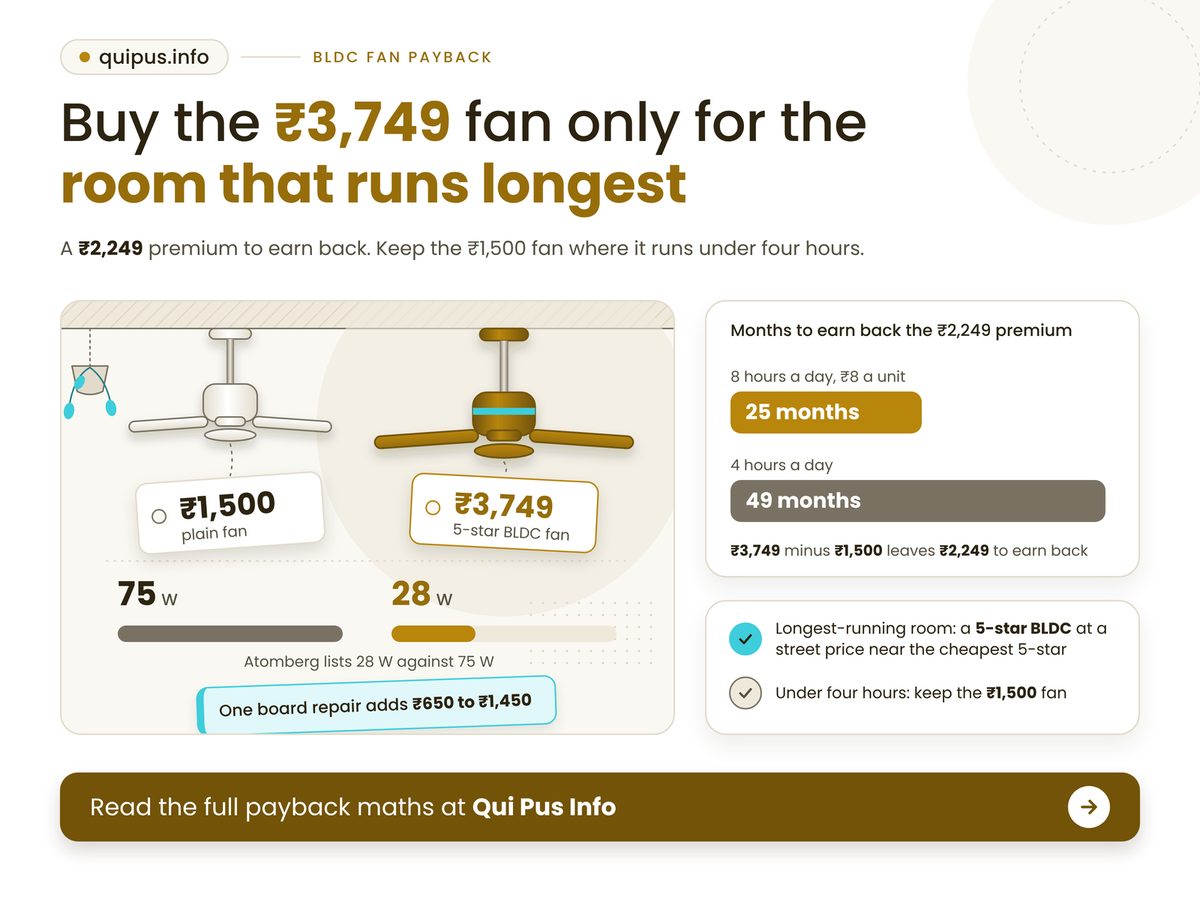
Buy a BLDC fan for any room that runs eight hours or more a day; below four hours, the ₹1,500 fan is the better buy.
- At 8 hours a day, ₹8 a unit and top speed, the ₹2,249 premium returns in about 25 months.
- At 4 hours the same fan takes about 49 months, past a 3-year warranty.
- A cheaper 5-star BLDC shrinks the premium to about ₹1,100.
- One out-of-warranty board repair costs ₹650 to ₹1,450 and stretches payback.
Why does BLDC fan payback swing so widely?
Because the saving is the wattage gap times your daily hours times your tariff, and the vendor's headline gap holds only at top speed, so any fan used less than that assumption repays far later.
Atomberg's own comparison page (fetched 31 October 2026) lists its BLDC fan at 28 W on speed 5 against 75 W for an ordinary fan, and claims 65% less power. Its table works out nearer 63%, and the gap narrows at lower speeds: 14 W against 45 W on speed 3, about two-thirds of the headline gap. The bedroom is where a BLDC earns its keep. Or rather, the room where the fan never switches off.
Atomberg listed the Renesa Prime at ₹3,749 as of 31 October 2026, a sale price that moves. CEEW's 2023 blog puts an unrated 75 W fan at about ₹1,500, so the premium is ₹2,249. It found the cheapest 5-star at ₹2,600, which cuts the premium to about ₹1,100, while the average 5-star MRP of ₹7,600 leaves about ₹6,100 to recover. Our gas vs electric geyser cost per bath comparison shows how a marginal slab is priced, and it matters as much as the fan.
CEEW's independent yardstick: swapping an unrated fan for a 5-star saves up to ₹500 a year. Divide the ₹2,249 premium by that and payback takes 4.5 years, double the vendor's arithmetic at eight hours. CEEW also notes induction motors can meet the 53 W minimum now mandated, a 29% cut from 75 W, so the BLDC's edge over a new plain fan is about 25 W. Our view: we found no published figure for the speed Indian homes run, so the true gap is unknown.
Premium Paid Up Front
₹2,249
Derived: the sum to earn back
Payback at CEEW's Saving
4.5 years
Derived: ₹2,249 over ₹500 a year
Units Saved Each Year
137 kWh
Derived: 47 W gap, 8 hours
Cut by a Minimum-Grade Fan
29%
Derived: 53 W against 75 W
That figure deserves suspicion both ways. "Up to" makes it a ceiling for a typical household, so your hours and tariff decide where you land beneath it. The same test on fridges: 3-star vs 5-star refrigerator: the 7-year wait.
Treat the vendor's 28 W against 75 W as a best case: it holds at top speed, and only a room that runs eight hours a day turns it into money.
How many years does a BLDC fan take to pay for itself?
At the top-speed gap, payback on a ₹3,749 fan against a ₹1,500 one runs from about a year for twelve hours at ₹10 a unit to over thirteen years for two hours at ₹5.
Find your daily hours, then read across at your bill's last-slab rate. Cells assume top speed and no repair.
| Hours a day | ₹5/unit | ₹8/unit | ₹10/unit |
|---|---|---|---|
| 2 hours | 13.1 yrs | 8.2 yrs | 6.6 yrs |
| 4 hours | 6.6 yrs | 4.1 yrs | 3.3 yrs |
| 8 hours | 3.3 yrs | 2.0 yrs | 1.6 yrs |
| 12 hours | 2.2 yrs | 1.4 yrs | 1.1 yrs |
The base case, 8 hours at ₹8, sits at 2.0 years. ₹5 stretches it to 3.3 years, and 4 hours doubles it to 4.1. At eight hours, any rate above roughly ₹5.50 a unit repays inside a 3-year warranty.
The question it settles: at 8 hours a day, is the ₹3,749 fan ahead of the ₹1,500 one before a 3-year warranty ends? It is, by about ₹1,000. Derived from Atomberg's 28 W against 75 W, ₹8 a unit and a 365-day year.
Worked example: assume a bedroom fan on top speed for 8 hours a day, ₹8 a unit, the ₹3,749 BLDC against the ₹1,500 fan, no repair. The gap is 75 W minus 28 W, so 47 W. Over a year, 47 W × 8 hours × 365 days ÷ 1,000 is 137 kWh, and 137 kWh × ₹8 is ₹1,098. Divide the ₹2,249 premium by ₹91.5 a month and you get 25 months. Your version: daily hours × 17.2 × your per-unit rate is rupees saved a year at top speed.
Do BLDC fans fail more often, and what does a repair cost?
We found no independent failure-rate study for BLDC fans, so the honest answer is unknown; what exists is owner reports of control-board faults and out-of-warranty fixes quoted at ₹650 to ₹1,450.
This evidence is anecdotal. A Crompton owner on a DesiDime thread (fan bought 2023, post dated about May 2026) had a failed board replaced free in warranty but was told it would otherwise cost ₹1,250 for the part plus ₹200 service. Another poster, around late 2024, was quoted ₹650 for a failed sensor board the technician said was not covered. On TechEnclave, an owner of nine BLDC fans reports two failures, one after warranty that could not be repaired at the time. Add one ₹1,450 board and the base case slides from 25 to about 40 months.
A star is a watts label, not a quality mark. Prayas Energy Group (20 April 2023) found every 5-star fan in the BEE database is BLDC, with average air delivery of 223 cmm against 215 for 1-star: about 4% more air, not a cooler room. We did not open BEE's current schedule, so check the label year on the box.
- Tariff: use your last unit's price from the bill's slab table, not the average.
- Sale tags: check price history first, as our guide to price-history lows against list-price percent off explains.
Check these about your own home before you buy
- You sleep on a low speed, so the speed-specific gap applies.
- The warranty page names the control board, not only the motor.
- You are replacing a dead fan or fitting a new room, not retiring a working one.
The decision: buy the 5-star BLDC for the room that runs longest, at a street price near the cheapest 5-star, and leave the ₹1,500 fan where it runs under four hours. This week, put your last bill's top slab rate and your busiest room's hours into the calculator above.
How we checked this
We read Atomberg's fan power comparison (31 October 2026), CEEW's labelling analysis (18 October 2023) and Prayas Energy Group's Up in the air (20 April 2023). BEE's labelling page was not opened, so star facts rest on CEEW and Prayas. Paybacks are our arithmetic on 8 hours, top speed and ₹8 a unit. No fan was tested hands-on; every wattage is Atomberg's. Last verified: 31 October 2026.
Edited by Ansari, reviewed after publication. Spotted something out of date? Tell us and we will correct it.
No comments:
Post a Comment
Note: Only a member of this blog may post a comment.