Twenty years of ₹2,000 a month costs you ₹4.8 lakh, and at 12% a year a standard calculator hands back ₹18.4 lakh. Work out SIP maturity after tax, exit load and inflation and the plan is worth ₹5.2 lakh in today's rupees. Buy that second number; plan around the first and you will be short.
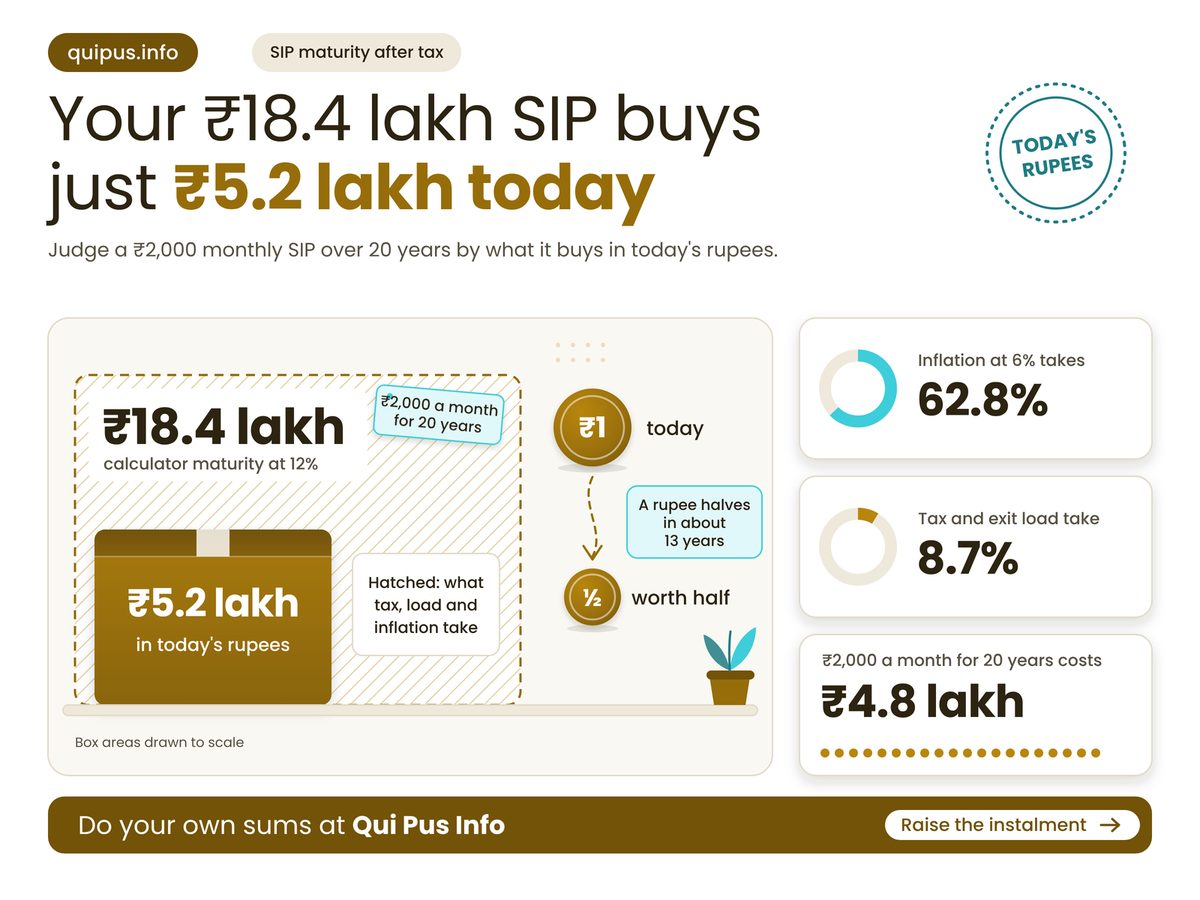
Judge a SIP by what it buys in today's rupees, because inflation takes several times more than tax and load together.
- Over 20 years at 12%, tax and exit load take under a tenth of the pot; inflation takes about six-tenths.
- Only the last twelve instalments can face the 20% short-term rate; older ones pay 12.5% above ₹1.25 lakh a year.
- Raise the instalment before you chase a fund or a tax trick: the amount is the lever you control.
What is SIP maturity after tax really worth?
The calculator's maturity figure is the most flattering number in your plan: take off tax and inflation, and a 20-year ₹2,000-a-month SIP at 12% keeps well under a third of it in purchasing power. Tax is the number people fear first, so start there, though it is the smaller worry.
DSP Mutual Fund's guide to SIP taxation, updated 17 July 2026, explains that every instalment has its own holding clock and the oldest units are sold first. Units held 12 months or less are taxed at 20%; older units at 12.5% on gains above ₹1.25 lakh a year across all your equity funds. So in a long SIP only the last twelve instalments meet the 20% rate, about ₹319 in our model. DSP's own example, a ₹5,000 SIP cashed in after about two years, owed just ₹1,800.
Exit load is the second small bill. SEBI's investor page describes it as a percentage of the redemption value charged for leaving early, with 1% within about a year as its equity example (retrieved 5 November 2026). Only the youngest twelve instalments are charged, so it costs about ₹255 here.
Inflation is the large bill. MoSPI's release of 12 October 2026, as reported by Business Today, put September retail inflation at 5.54%. At that rate a rupee loses half its buying power in about 13 years, so the 6% used here is fair; we would add a point or two if school fees are in your goal.
These four numbers decide whether the plan holds up: how fast a rupee shrinks, what you pay in, what tax takes, and what your fund earns above prices.
Years Until a Rupee Halves
13 years
At September 2026 inflation, derived
Tax and Exit Load Paid
₹1.61 lakh
Derived: under a tenth of maturity
Instalments Paid In
240
Each taxed on its own clock
Real Return After Inflation
5.7% a year
Derived: 12% fund, 6% inflation
The real return deserves the most attention. It depends only on the gap between your fund and prices, so a fund that merely keeps pace adds nothing. Most SIP advice says compare funds and hunt tax savings; we would not, because the amount and the years are what you control. Pricing the whole life also decides when a ₹3,749 BLDC fan beats a ₹1,500 one and the 7-year wait on a 5-star refrigerator.
A rupee that halves in about 13 years turns the maturity column into a promise in the wrong currency.
Which horizon and return leave how many rupees?
A ₹2,000 monthly SIP leaves between about ₹2.0 lakh and ₹5.2 lakh in today's rupees across 10 to 20 years at 8% to 12%, assuming 6% inflation; the table shows every pairing.
Find your row, then read across at your assumed return. Each cell is the in-hand amount after tax and load, deflated at 6% a year; L means lakh.
| Years held (today's ₹) | At 8% | At 10% | At 12% |
|---|---|---|---|
| 10 years | ₹2.0L | ₹2.2L | ₹2.4L |
| 15 years | ₹2.7L | ₹3.2L | ₹3.7L |
| 20 years | ₹3.4L | ₹4.2L | ₹5.2L |
The tinted cell is the base case. One step left, to a 10% return, takes it to ₹4.2L; one row up, to 15 years, takes it to ₹3.7L. Time moves the answer more than return does.
Check yours in a minute: divide any calculator's maturity by 1.06 once per year held (1.8 for ten years, 2.4 for fifteen, 3.2 for twenty), then trim a few percent for tax and load.
Worked example: ₹2,000 goes in on the first of each month for 20 years at 12% a year, with 6% inflation, 1% exit load, 4% cess, one redemption and no other equity gains. You pay in ₹4,80,000 and the pot reaches ₹18,39,715. The last twelve instalments carry ₹1,533 of gain, taxed at 20% plus cess: about ₹319. The older gain, ₹13,58,182 less the ₹1,25,000 exemption, is taxed at 12.5% plus cess: about ₹1,60,314. With ₹255 of exit load, ₹1,60,888 goes, leaving ₹16,78,827. Divide by 1.06 twenty times (3.207) for ₹5,23,466 in today's rupees.
The decision this settles: worry about inflation before tax, by more with every extra year. Derived from our model of a ₹2,000 monthly SIP at 12% and 6% inflation, with tax rules from DSP Mutual Fund's guide.
Where do SIP tax and inflation estimates go wrong?
Two assumptions move the answer most: how you withdraw and whether the expense ratio is counted twice, and a yearly step-up changes it too, so treat any figure as a range.
Withdrawal comes first. The ₹1.25 lakh exemption resets every financial year, so cashing out at once, as our model does, uses it once; staged withdrawals should use it repeatedly. An investor on r/IndianStockMarket argued in December 2025 that calculators show only nominal rupees; replies noted that fund returns already net out the expense ratio. One user's view, not a finding; no figure here rests on it.
Step-ups cut the other way: a SIP you raise yearly ends bigger than our flat one, so enter your average instalment. A flattering headline works in a shop too, which is why telling a fake discount from a real low comes down to one number.
- Tax rates here are as of November 2026; confirm them on the Income Tax Department's site before redeeming.
- Other equity gains this year use up the ₹1.25 lakh first, so your tax would exceed the model's.
- Debt funds bought after 1 April 2023 are taxed at your slab rate, so none of this applies.
Check these about your own situation
- Your goal is more than ten years away, so price it in today's rupees.
- You may redeem within a year or two, when exit load bites a small pot.
- You sell no other equity this year; if you do, the model understates your tax.
This week, enter your amount and years in your fund app's SIP calculator, divide the maturity by the factor above, and compare the result with your goal. If it falls short, raise the monthly instalment before touching fund choice or tax planning: that is the decision, and the one you control. It is wrong advice if you need the money within two years, so read your scheme's exit load first.
How we checked this
We read DSP Mutual Fund's SIP tax guide (updated 17 July 2026) and SEBI's exit load page (retrieved 5 November 2026). The inflation rate comes from the MoSPI September 2026 release, which we could not open, so we cite it as reported by Business Today. The worked example is our own arithmetic. No product was tested hands-on for this article. Last verified: 5 November 2026. Edited by Ansari, reviewed after publication. Spotted something out of date? Tell us and we will correct it.
No comments:
Post a Comment
Note: Only a member of this blog may post a comment.